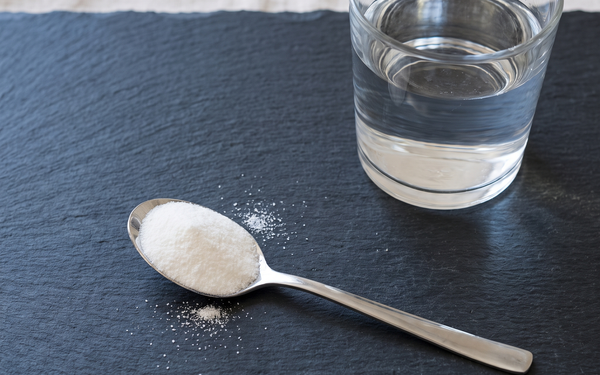


In a study published in the European Journal of Applied Physiology, researchers dehydrated six men by about 1.9 percent of body mass, then gave them a fixed volume of fluid to drink. When that fluid was essentially plain water, the men finished the recovery period in a net negative fluid balance of 689ml. They had drunk a known quantity, and most of it had already left through their kidneys. When the same volume of fluid contained a meaningful amount of sodium, they finished in positive balance, having actually retained what they drank.
Same volume. Same people. Same protocol. The only variable that changed was sodium. And it was the difference between staying dehydrated and getting properly rehydrated.
This is one of the most counterintuitive findings in hydration science, and it cuts against everything the eight-glasses-a-day culture has taught us. The amount of water you drink is not the same as the amount of water your body keeps. Those are two different numbers, and the gap between them is governed largely by a single mineral.
THE PROBLEM WITH DRINKING MORE WATER
Most people treat hydration as a volume problem. Feel a bit foggy, a bit tired, a bit headachey at 3pm? Drink more water. Carry the litre bottle. Tick off the app. The assumption underneath all of this is simple: the more water goes in, the more hydrated you are.
It is not that straightforward, and the reason is your kidneys.
Your body does not measure hydration by how full your stomach is. It monitors the concentration of your blood, specifically the concentration of sodium and other particles dissolved in it. This is called plasma osmolality, and your body defends it within an extremely tight range. When you drink a large volume of plain water quickly, you dilute your blood. Plasma osmolality drops. Your body reads this as a threat and acts fast to correct it.
The correction is to get rid of the excess water. Plain water, in other words, can trigger the very response that flushes it back out before your cells have made full use of it. You drink, you feel briefly better, and then you are in the toilet twenty minutes later wondering why you still feel flat. The volume went in. It did not stay.
THE SCIENCE OF WHY WATER FOLLOWS SODIUM
To understand why sodium changes this, you have to follow water on its actual journey into your body. Water is not absorbed in the stomach. It is absorbed in the small intestine, and it does not cross the gut wall on its own. It is pulled across, and the thing doing the pulling is sodium.
Think of the wall of your small intestine as a series of one-way turnstiles. Water molecules cannot simply walk through. They have to follow something. The primary something is sodium. Specialised transporter proteins in the gut wall move sodium from the inside of your intestine into the cells lining it. Water follows by osmosis, because water always moves toward the higher concentration of dissolved particles. Move sodium across the wall, and water is dragged along behind it. No sodium gradient, far less water transport. You can read about sodium and its role in nutrient transport for the broader picture of what electrolytes are doing in the body at the cellular level.

The diagram above shows how this works at the cellular level. A 2024 review published in the journal Nutrients laid out the mechanism in detail. Sodium is actively co-transported across the intestinal lining, and in doing so it creates an osmotic gradient that facilitates water absorption. The review noted that this coupled movement of sodium and water moves fluid more effectively than water presented to the gut on its own. It also made a point that surprises most people: hypotonic fluids, drinks that are slightly less concentrated than your blood, with sodium but little sugar, are absorbed faster in the small intestine than plain water or heavily sweetened isotonic sports drinks. The drink that hydrates fastest is not the most watery one. It is the one with the right amount of sodium in it. For a broader view of how electrolytes work together in the body, the earlier piece on electrolytes covers the full cast of minerals.
This is where it gets interesting. The same mineral that pulls water into your body also determines whether you keep it once it is in. Sodium is the main solute in the fluid outside your cells, the extracellular fluid that includes your blood plasma. When you take in sodium alongside water, you raise the solute content of that compartment just enough to hold the water there rather than dumping it. Your plasma osmolality stays in its happy zone, your body does not panic, and the kidneys do not slam open the floodgates. The water stays in circulation, available to your cells, instead of being marked for immediate eviction.
The clearest demonstration of this comes from post-exercise rehydration research. In the 1995 European Journal of Applied Physiology study mentioned at the top, the researchers gave their six dehydrated participants drinks containing four different sodium concentrations, from near-zero up to a high dose. The result was a clean, dose-dependent line: the fraction of the fluid retained was directly related to the sodium concentration of the drink. The near-water drink left people 689ml in deficit. The highest-sodium drink left them in positive balance at plus 98ml. Every step up in sodium meant more water kept and less water lost.
A larger follow-up study by Shirreffs and colleagues, published in Medicine and Science in Sports and Exercise in 1996, tested the interaction between how much you drink and how much sodium is in it. Twelve men were dehydrated by around two percent of body mass and rehydrated with different combinations of volume and sodium content. The headline finding was blunt. Drinking a volume greater than your sweat loss, the standard advice to drink generously after exercise, simply produced more urine unless the sodium content of the drink was high enough. You can drink as much as you like. Without sodium, a large share of it is destined for the bladder, not the bloodstream.
THE BEVERAGE THAT BEATS WATER
If sodium drives retention, you would expect drinks with sodium to out-hydrate plain water in a head-to-head test. That is exactly what one of the most cited hydration studies of the last decade found.
In 2016, Maughan and colleagues published a randomised trial in the American Journal of Clinical Nutrition that set out to rank everyday drinks by how well they hydrate. They recruited 72 men, gave each of them one litre of a test drink over half an hour, and then measured urine output across the following four hours. From this they built what they called the Beverage Hydration Index, a simple score comparing how much fluid each drink kept in the body relative to still water.
Plain water was the reference point, scored at 1.0. The drinks that beat it were not the ones you might guess. An oral rehydration solution, the sodium-rich formula used to treat dehydration, scored around 1.5. Both full-fat and skimmed milk scored similarly high. These drinks left noticeably less fluid in the collection bottles four hours later, meaning more had stayed in the body. The common thread among the top performers was that they contained either electrolytes, particularly sodium, or a modest amount of nutrients that slow the rate at which fluid empties from the stomach and reaches the kidneys. Drinks closest to plain water in composition clustered around water itself. Water is a perfectly fine drink. It is just not, on this measure, the most effective way to actually stay hydrated.
WHAT YOU ACTUALLY LOSE WHEN YOU SWEAT
There is one more piece, and it is the reason this matters for anyone who trains rather than just sits at a desk. When you sweat, you do not only lose water. You lose sodium, and you lose a lot of it.
Normative data from Baker and colleagues, published in the Journal of Sports Sciences in 2016, put average sweat sodium concentration at roughly 800 to 2,000mg per litre, with wide variation between individuals. A single hour of hard training can cost you anywhere from half a litre to well over a litre of sweat. Do the arithmetic and a normal session can drain 800 to 1,500mg of sodium straight out of you, sometimes considerably more for heavy or salty sweaters.
So picture the common scenario. You finish a hard session, you have lost both water and sodium, and you reach for a big glass of plain water. You have replaced one of the two things you lost. Worse, by adding water without sodium, you dilute the sodium that remains, dropping your plasma osmolality further and giving your kidneys even more reason to flush the water you just drank. You can end up having drunk a litre and being, in terms of what your cells can actually use, barely better off than when you started. This is the trap behind the all-too-common feeling of being waterlogged but still flat.
SO WHAT DOES THIS MEAN FOR YOU
The practical takeaway is not to drink less water. Water is essential and most people genuinely could drink a bit more of it. The point is that water alone is an incomplete tool, and for active people it is missing its most important component.
The fix is simple. When hydration actually matters, when you wake up after a night of mild overnight dehydration, before or after a training session, or on a hot day, get some sodium in alongside the fluid. The research consistently points to the same principle: a drink with a meaningful amount of sodium is retained far better than plain water, because it works with your physiology rather than against it. As a practical anchor, the rehydration literature finds clear benefits once a drink reaches roughly 50 to 60mmol of sodium per litre, which is considerably more than the 10 to 25mmol you find in a typical sports drink. You can read more about why active people need more sodium than public guidelines suggest for a fuller look at the evidence behind sodium intake for people who train.
A concrete tip you can use tomorrow morning. Instead of starting the day with plain water on an empty stomach, where much of it passes straight through, have your first drink contain some sodium. You will retain more of it, your plasma osmolality recovers more smoothly after the overnight fast, and you spend less of the morning visiting the bathroom. It is a small change with a measurable effect on whether the water you drink actually stays.
This is precisely the logic behind why we built Creayate with 800mg of sodium per sachet rather than the token amounts found in most drinks. The figure was chosen with the rehydration research in this article in mind: it is a meaningful contribution to the sodium intake of someone who trains and sweats, rather than a trace amount. Creayate is a food supplement and is not a substitute for a varied, balanced diet, and the right sodium intake for any individual depends on their own diet, training and health, which is a conversation to have with a qualified healthcare professional. And if you are curious about how your creatine reaches the muscle, sodium's role in that transport is one reason it belongs in the same sachet.
Key Takeaways
- Hydration is governed by how much fluid you retain, not how much you drink, and sodium is the main factor that determines retention.
- Water is absorbed in the small intestine by following sodium across the gut wall, so without a sodium gradient far less water actually crosses into the body.
- In controlled rehydration studies, plain water left dehydrated people in a net fluid deficit, while sodium-containing drinks of the same volume left them in positive balance.
- The Beverage Hydration Index ranked sodium-rich drinks and milk above plain water for keeping fluid in the body over four hours.
The bottom line: Drinking more water is not the same as being more hydrated, and sodium is what closes the gap between the two.
Sources
- Maughan RJ, Leiper JB. Sodium intake and post-exercise rehydration in man. European Journal of Applied Physiology and Occupational Physiology. 1995;71(4):311-319.
- Maughan RJ, Watson P, Cordery PAA, et al. A randomized trial to assess the potential of different beverages to affect hydration status: development of a beverage hydration index. American Journal of Clinical Nutrition. 2016;103(3):717-723.
- Shirreffs SM, Taylor AJ, Leiper JB, Maughan RJ. Post-exercise rehydration in man: effects of volume consumed and drink sodium content. Medicine and Science in Sports and Exercise. 1996;28(10):1260-1271.
- Pérez-Castillo IM, Williams JA, López-Chicharro J, et al. Compositional aspects of beverages designed to promote hydration before, during, and after exercise. Nutrients. 2024;16(1):17.
- Baker LB, Barnes KA, Anderson ML, et al. Normative data for regional sweat sodium concentration and whole-body sweating rate in sport. Journal of Sports Sciences. 2016;34(4):358-368.
This article is for informational purposes only and is not intended as medical advice. If you have specific health concerns, particularly regarding blood pressure, kidney function, or cardiovascular health, consult a qualified healthcare professional before changing your sodium or fluid intake.