

Two people can walk off the same pitch after the same hour-long match having lost completely different amounts of salt. One might have sweated out a few hundred milligrams of sodium. The other, over two grams. Same sport, same session, same weather, and a difference of several times over. That gap is the single most important thing to understand about sweat, and it is the thing a simple chart can never quite capture.
This article is that chart anyway, because the numbers are genuinely useful as a starting point. The research now gives us decent normative data on how much people lose, by sport, in both fluid and sodium. But the honest version comes with a warning printed across the top: the sport sets the rough terrain, and you set your own position on it. By the end you will know the typical ranges, and you will know how to find your own, which is the only figure that actually matters.
THE TWO THINGS YOU LOSE
Sweat loss is really two separate measurements, and conflating them is where most people go wrong.
The first is your sweat rate: how much fluid you lose per hour, measured in litres. The second is your sweat sodium concentration: how salty that fluid is, measured in milligrams of sodium per litre. These are different axes, and here is the part that surprises people: they are largely independent of each other. A 2019 review by Baker, the field's standard reference, found that at the whole-body level how fast you sweat barely predicts how salty your sweat is. You can be a heavy sweater with dilute sweat, a light sweater with very salty sweat, or any combination. Knowing one tells you little about the other.
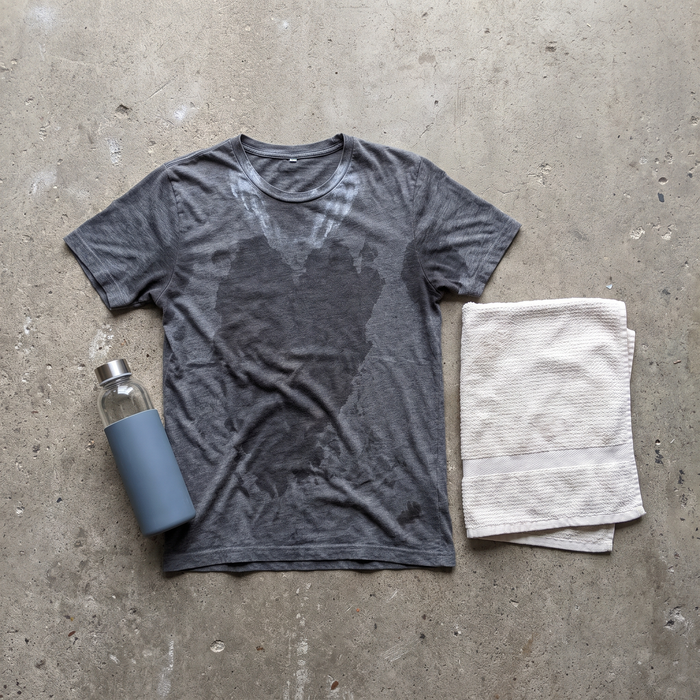
Why is saltiness so individual? As sweat travels up the gland's duct toward the skin, your body reabsorbs some of the sodium back, like a filter reclaiming salt before it is lost. How efficiently you do that is set largely by genetics and by the hormone aldosterone, not by how hard you are working. Some people reclaim most of their sweat sodium and lose dilute sweat; others reclaim little and lose salty sweat, leaving those tell-tale white marks on a dark shirt. It is one of the more heritable things about you, and no amount of training changes the basic setting, though heat acclimatisation can turn the dial down for a while.

The diagram above plots those two axes. Keep both in mind as we walk the map, because the total sodium you lose is the two multiplied together, and each can swing widely on its own.
WHAT THE NUMBERS ACTUALLY ARE
Start with the broad ranges, because they frame everything else. Across exercise, the National Athletic Trainers Association puts sweat rates anywhere from 0.5 to 4.0 litres per hour. A large 2016 dataset from Baker and colleagues, covering 506 athletes, found an average whole-body sweat rate of about 1.2 litres per hour, but with individuals ranging from roughly a quarter of a litre to nearly 5.7 litres per hour. That is more than a twentyfold spread between the lightest and heaviest sweaters.
Sweat sodium shows a similar story. In that same 2016 dataset, the average whole-body sweat sodium concentration was around 800 milligrams per litre, but the range ran from roughly 400 to 1,600 milligrams per litre. So at the extremes, a heavy, salty sweater can lose something like ten times the sodium per hour of a light, low-sodium sweater doing the exact same activity. Ten times. No chart organised by sport can survive a difference that large between two people in the same row.
THE MAP BY SPORT
With that firmly in mind, here is what the by-sport data shows. A 2019 normative analysis by Barnes and colleagues, covering more than 1,300 athletes, broke sweat rates down by sport. American football came out highest at around 1.5 litres per hour on average. Endurance sports such as running sat around 1.3 litres per hour. Basketball and soccer landed close to 0.9 to 1.0 litres per hour. Baseball was lower, around 0.8.
Those are averages, and the spread around each one is enormous, large enough that the sports overlap almost completely. A heavy-sweating footballer and a light-sweating American footballer can easily swap places. Treat these as the centre of a wide cloud, not a fixed value for your sport.
Some individual studies put concrete numbers on specific sports. A 2007 study by Maughan and colleagues measured competitive footballers during a match in cool conditions and found an average total sweat loss of about 1.7 litres over the game, with sweat sodium around 1,400 milligrams per litre, adding up to roughly 2.4 grams of sodium lost in 90 minutes. A 2017 study by Lara and colleagues followed 51 marathon runners and measured sweat rates of around 0.9 to 1.0 litres per hour. These are real figures from real athletes, and they still sit inside those wide, overlapping ranges.
A few popular activities have surprisingly little hard data. Padel, despite its boom, has essentially no published sweat figures, and tennis appears only sparingly, so for racquet sports the honest answer is that they fall within the general range for intermittent exercise and you will have to measure your own. Weight training has no clean per-hour dataset either, though losses tend to be lower and more stop-start than continuous endurance work. Hot yoga has been measured only once that is worth citing, a small 2020 pilot of just five participants, which found sweat losses of around 1.5 litres in a 90-minute Bikram session with notably salty sweat. With a sample that small, treat it as a hint, not a fact: hot yoga can clearly drive losses on a par with hard endurance exercise, but the exact number is not settled.
THE LIGHT, AVERAGE AND HEAVY SWEATER
The most useful way to hold all this is to picture three people, anchored to the real data.
The light sweater loses maybe 0.3 to 0.5 litres an hour, with dilute sweat around 400 milligrams of sodium per litre. An hour of training might cost them a couple of hundred milligrams of sodium. The average sweater loses around 1.2 litres an hour at roughly 800 milligrams per litre, so about 800 milligrams to a gram of sodium in that hour. The heavy, salty sweater loses 2 litres an hour or more at up to 1,600 milligrams per litre, which adds up to 3 grams of sodium or beyond in a single hard session.
This is where it gets interesting, because it explains why blanket advice fails. The same electrolyte product that comfortably covers the light sweater barely touches the heavy one. And the difference is not mainly about the sport. It is about you, and it shifts further with heat, fitness and acclimatisation. Train in the heat for a couple of weeks and your body actually learns to conserve sodium, cutting your sweat sodium concentration substantially. Your dot on the map moves.
HOW TO MAP YOUR OWN
Because of all this, the genuinely useful map is the one you draw on yourself, and the method is almost embarrassingly simple. The National Athletic Trainers Association and the American College of Sports Medicine both endorse the same approach.
Weigh yourself, nearly naked and towelled dry, immediately before a training session. Train for a known length of time, keeping track of any fluid you drink. Towel off and weigh yourself again straight after. The weight you have lost, plus whatever you drank, is your sweat loss, and the handy rule is that one kilogram of body mass lost is about one litre of sweat. Divide by the hours you trained and you have your personal sweat rate, which beats any chart. Do it once on a hot day and once on a cool one, and you will quickly see how much your own losses swing with the weather and the intensity rather than with the name of the activity, which is exactly the point the sport-by-sport averages tend to hide.
Reading your sweat sodium without a lab is rougher, but there are signs. White, crusty salt marks on a dark training top after it dries, sweat that stings your eyes badly, or a distinctly salty taste are all rough indicators of a saltier sweater. A dedicated sweat test, covered in its own article, goes further, but those everyday signs will tell you which third of the map you are likely in.
WHAT TO DO WITH IT
Use the sport ranges as a first estimate, then personalise. For short, cool sessions, none of this matters much and water is usually fine. For long, hot or hard sessions, especially if you are an average-to-heavy sweater, replacing fluid alone leaves the sodium gap open, and that is where performance and how you feel afterwards start to suffer. Heat and humidity widen the gap further, because they push your sweat rate up without you necessarily noticing, so the same hour in a sticky August evening costs you more than it does in March.
The practical point is to match your sodium replacement to what you actually lose. An average hour of hard training costs roughly 800 milligrams of sodium, which is why we built Creayate with 800 milligrams of sodium per sachet, sized to match that typical hourly loss. Heavy sweaters will need more than that across a long session, light sweaters less. Creayate is a food supplement and not a substitute for a balanced diet, and your own needs depend on your sweat, your sport and your conditions.
The single thing to do tomorrow: weigh yourself before and after your next session. Two minutes on the scales will tell you more about your real losses than any map organised by sport ever could.
Key Takeaways
1. Sweat loss has two independent measures: how much you sweat, around 0.5 to 2 litres an hour for most people, and how salty it is, roughly 400 to 1,600 milligrams of sodium per litre. 2. Because the two vary independently and widely, a heavy salty sweater can lose around ten times the sodium per hour of a light one doing the same activity. 3. Average sweat rates by sport range from roughly 0.8 to 1.5 litres an hour, but the spread within each sport is so large that the sports overlap almost completely. 4. The only figure that really matters is your own, found by weighing yourself before and after a session, where one kilogram lost is about one litre of sweat.
The bottom line: A sweat map by sport is a useful starting point, but individual variation dwarfs the sport, so measure your own losses and replace fluid and sodium in proportion to them.
SOURCES
1. Baker LB, Barnes KA, Anderson ML, et al. Normative data for regional sweat sodium concentration and whole-body sweating rate in athletes. Journal of Sports Sciences. 2016;34(4):358-368. https://pubmed.ncbi.nlm.nih.gov/26070030/
2. Baker LB. Physiology of sweat gland function: the roles of sweating and sweat composition in human health. Temperature. 2019;6(3):211-259. https://pmc.ncbi.nlm.nih.gov/articles/PMC6773238/
3. Barnes KA, Anderson ML, Stofan JR, et al. Normative data for sweating rate, sweat sodium concentration, and sweat sodium loss in athletes: an update and analysis by sport. Journal of Sports Sciences. 2019;37(20):2356-2366. https://pubmed.ncbi.nlm.nih.gov/31230518/
4. Maughan RJ, Watson P, Evans GH, et al. Water balance and salt losses in competitive football. International Journal of Sport Nutrition and Exercise Metabolism. 2007;17(6):583-594. https://pubmed.ncbi.nlm.nih.gov/18156663/
5. Lara B, Salinero JJ, Areces F, et al. Sweat sodium loss influences serum sodium concentration in a marathon. Scandinavian Journal of Medicine and Science in Sports. 2017;27(2):152-160. https://pubmed.ncbi.nlm.nih.gov/26661748/
6. Alrefai H, Mathis SL, Hicks SM, et al. Salt and water balance after sweat loss: a study of Bikram yoga. Physiological Reports. 2020;8(22):e14647. https://pubmed.ncbi.nlm.nih.gov/33230967/
7. McDermott BP, Anderson SA, Armstrong LE, et al. National Athletic Trainers' Association position statement: fluid replacement for the physically active. Journal of Athletic Training. 2017;52(9):877-895. https://pubmed.ncbi.nlm.nih.gov/28985128/
8. Sawka MN, Burke LM, Eichner ER, et al. American College of Sports Medicine position stand. Exercise and fluid replacement. Medicine and Science in Sports and Exercise. 2007;39(2):377-390. https://pubmed.ncbi.nlm.nih.gov/17277604/
This article is for informational purposes only and is not intended as medical advice. If you have high blood pressure, are sensitive to sodium, or have any heart or kidney condition, consult a qualified healthcare professional before changing your sodium or fluid intake. </content>