

Search the entire research literature for a controlled trial of creatine in healthy children under the age of twelve and you will come up empty. There is not one.
That is worth sitting with for a moment, because creatine is now everywhere. It is discussed on every health podcast a parent might stumble across, marketed for brain health as much as for the gym, and increasingly asked about for the whole family. So it is reasonable to assume the safety question in children has been settled one way or the other. It has not. The honest answer is more interesting, and more useful, than a simple yes or no, and it starts with separating two groups of children the research treats very differently.
THE QUESTION HAS TWO HALVES
When a parent asks whether creatine is safe for their child, they are usually picturing a healthy nine or ten year old who plays football at the weekend. The instinct is to look for a clean yes or no. But the body of evidence on creatine in children is almost entirely about children with specific medical conditions, where creatine is used as a treatment, under medical supervision, often at doses far higher than anything an athlete would take.
Reading that evidence as a green light for a healthy child is a category error. It is a bit like pointing to the fact that doctors prescribe powerful steroids to children with severe asthma and concluding that steroids must be fine for any child to take. The context is everything. So let us take the two worlds in turn, because both are real and they lead to different conclusions.
WORLD ONE: CHILDREN WHO ARE TREATED WITH CREATINE
Some children are born unable to make creatine properly. In a group of rare genetic conditions known as creatine deficiency syndromes, the body cannot synthesise or transport creatine normally, and the developing brain, which depends heavily on it, suffers as a result. For these children, creatine is not a supplement in any meaningful sense. It is a treatment.
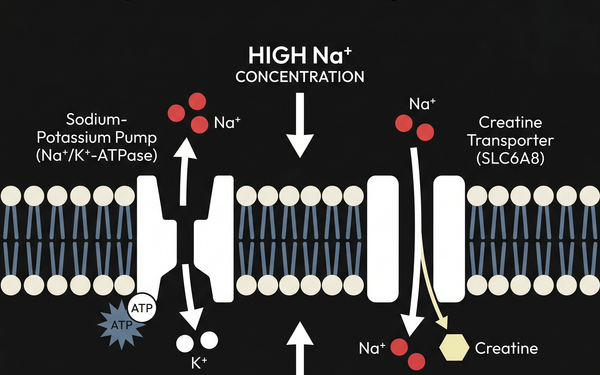
To understand why that is treatment rather than enhancement, it helps to know what creatine does in a child's body. Creatine is part of the system that recycles cellular energy, and the brain, which is growing and wiring itself rapidly all through childhood, is one of the most energy-hungry organs there is. A child who cannot make or move creatine normally is short of a basic raw material for that process, which is why the consequences show up as developmental and neurological problems. Replacing the missing creatine addresses the shortage directly. That is a world away from adding extra to a child who already has plenty.
A 2014 international outcomes study by Stockler-Ipsiroglu and colleagues, published in Molecular Genetics and Metabolism, followed 48 individuals with one such condition, GAMT deficiency. Treatment with creatine monohydrate, often at high doses alongside dietary changes, improved or stabilised symptoms, and the children treated earliest had the best developmental outcomes. This is the strongest paediatric creatine evidence that exists, and it is in seriously ill children for whom the alternative was far worse.
The other well-studied group is children with muscular dystrophy. A 2013 Cochrane systematic review by Kley, Tarnopolsky and Vorgerd pooled 14 randomised controlled trials covering 364 people with various muscle disorders, including paediatric Duchenne muscular dystrophy. Short to medium term creatine increased muscle strength by around 8.5 percent in the muscular dystrophies, more participants reported feeling better, and, importantly, no trial reported any clinically relevant adverse event. A dedicated 2004 trial by Tarnopolsky and colleagues in Neurology tested creatine in 30 boys with Duchenne muscular dystrophy, average age around ten, and found it improved strength and lean mass and was well tolerated.

The diagram above shows how lopsided the evidence is. The Cochrane review is also honest about limits: creatine did not help metabolic myopathies and actually worsened one rare condition called McArdle disease. The benefit is specific to particular diseases, not a general boost. What this world tells us is narrow but real: under medical supervision, for specific conditions, creatine has been given to children safely. It tells us nothing about whether a healthy child should take it.
WORLD TWO: HEALTHY CHILDREN
Here the picture changes completely, because the cupboard is close to bare.
The most thorough review of the area, by Jagim and Kerksick in the journal Nutrients in 2021, lays it out plainly. The handful of studies looking at creatine and athletic performance in young people, around nine of them, were all conducted in adolescents aged roughly 15 to 18, in sports like swimming and football. There are no performance trials in healthy children under 12, and no studies on creatine and cognitive performance in healthy children. The same review notes that no studies have specifically examined safety in healthy young athletic populations. The evidence for healthy children is not weak or mixed. It is largely absent.
This is where it gets interesting, because absence cuts two ways. On the one hand, the safety record in the children who have been studied, the sick ones, is genuinely reassuring. No clinically relevant adverse events across the Cochrane trials is a meaningful signal. It is part of why bodies like the International Society of Sports Nutrition, in their 2017 position stand led by Kreider and colleagues, state that there is no scientific evidence that children or adolescents should not take creatine, and describe the common "not suitable for under 18s" label as a legal precaution rather than a proven hazard. A 2025 perspective in Frontiers in Nutrition from a similar group goes further, arguing creatine is safe across the lifespan and should not be restricted.
On the other hand, absence of evidence of harm is not the same thing as evidence of benefit. For a child being treated for a disease, there is a clear problem to weigh creatine against. For a healthy child, there is no demonstrated benefit to place on the other side of the scale at all. You would be accepting even a small unknown in exchange for nothing the research can currently promise. That is a different calculation entirely, and it is the one most parents are actually facing.
This is also where mainstream guidance lands. The default advice from paediatric and dietetic bodies is that children should get what they need from a balanced diet, and that any supplement be considered only with a healthcare professional involved. It is not that creatine has been singled out as uniquely dangerous for children. It is that the bar for giving a healthy, growing child anything beyond food is, quite rightly, high, and on the question of benefit creatine has not cleared it. Where there is a clear need and a real upside, as in the treated conditions above, the calculation favours acting. Where there is no demonstrated upside, caution is not timidity. It is just good sense.
WHAT ABOUT VEGETARIAN AND VEGAN CHILDREN
One reasonable question deserves its own mention. Creatine in the diet comes almost entirely from meat and fish, so children who eat neither take in less of it, relying more on what their bodies make. In adults, vegetarians do have lower muscle creatine, and in one 2011 trial by Benton and Donohoe, vegetarian adults showed a cognitive benefit from supplementation that omnivores did not.
It is tempting to extend that to vegetarian and vegan children, but it has not been directly studied in them, and a growing child is not a small adult. How much it matters is genuinely uncertain: the body's own production compensates to a degree, and a child who is vegetarian rather than fully vegan still gets some creatine-related nutrients through eggs and dairy. Nobody has measured it properly in children. The sensible reading is that lower dietary creatine in a plant-based child is a fair thing to raise with a paediatric dietitian, not a settled reason to start supplementing. A well-planned vegetarian or vegan diet is the foundation, and any supplement question sits on top of that conversation, not instead of it.
WHAT THIS MEANS FOR PARENTS
The practical takeaway is refreshingly clear, even if it is not a tidy yes or no.
For a healthy child, there is currently no evidence that creatine improves anything, and no controlled safety data in the under 12s, which together mean it is not something to start giving a child on your own initiative. A balanced diet already supplies creatine through meat and fish, and a child's body makes the rest. The case for supplementing a healthy child simply has not been made.
It is worth remembering how modest a child's needs are and how well ordinary food meets them. A child eating a reasonable mix of foods, with some meat or fish in it, is already taking in dietary creatine, and their body tops up the rest through its own production. The gap a supplement might plausibly fill in an adult athlete chasing performance is not the same situation as a growing child whose ordinary diet and physiology are already doing the job between them.
If your child has a medical condition, that is a completely different conversation, and a genuinely important one, to have with their specialist, who may well use creatine as part of treatment. And for any supplement question in a child, healthy or not, the right first move is a chat with your GP, paediatrician or a registered paediatric dietitian rather than a purchase. To be clear about our own position, Creayate is a food supplement formulated for adults, not for children, and is not intended for use by under 18s.
One thing you can do today: if you have been wondering about creatine or any supplement for your child, write the question down and take it to your next appointment with a healthcare professional. It is exactly the kind of thing they would rather you asked than guessed at. The fact that creatine is having a cultural moment among adults is not, by itself, a reason to extend it to children, and a good clinician will help you separate the genuine signal from the noise.
Key Takeaways
1. There are no controlled trials of creatine in healthy children under 12, for either performance or cognition, so its use in healthy children is simply not established. 2. The bulk of paediatric creatine research is in children with specific medical conditions, such as creatine deficiency syndromes and muscular dystrophy, where it is used therapeutically under supervision. 3. In those studied groups the safety record is reassuring, but absence of harm is not the same as evidence of benefit for a healthy child. 4. Any decision about creatine for a child should be made with a GP, paediatrician or paediatric dietitian, not on your own.
The bottom line: Creatine is well studied and broadly safe in children treated for specific conditions, but there is no evidence it benefits healthy children, so it is a question for a paediatrician, not a default.
SOURCES
1. Jagim AR, Kerksick CM. Creatine supplementation in children and adolescents. Nutrients. 2021;13(2):664. https://pubmed.ncbi.nlm.nih.gov/33670822/
2. Stockler-Ipsiroglu S, van Karnebeek C, Longo N, et al. Guanidinoacetate methyltransferase (GAMT) deficiency: outcomes in 48 individuals and recommendations for diagnosis, treatment and monitoring. Molecular Genetics and Metabolism. 2014;111(1):16-25. https://pubmed.ncbi.nlm.nih.gov/24268530/
3. Kley RA, Tarnopolsky MA, Vorgerd M. Creatine for treating muscle disorders. Cochrane Database of Systematic Reviews. 2013;(6):CD004760. https://pubmed.ncbi.nlm.nih.gov/23740606/
4. Tarnopolsky MA, Mahoney DJ, Vajsar J, et al. Creatine monohydrate enhances strength and body composition in Duchenne muscular dystrophy. Neurology. 2004;62(10):1771-1777. https://pubmed.ncbi.nlm.nih.gov/15159476/
5. Kreider RB, Kalman DS, Antonio J, et al. International Society of Sports Nutrition position stand: safety and efficacy of creatine supplementation in exercise, sport, and medicine. Journal of the International Society of Sports Nutrition. 2017;14:18. https://pubmed.ncbi.nlm.nih.gov/28615996/
6. Benton D, Donohoe R. The influence of creatine supplementation on the cognitive functioning of vegetarians and omnivores. British Journal of Nutrition. 2011;105(7):1100-1105. https://pubmed.ncbi.nlm.nih.gov/21118604/
7. Kreider RB, Jagim AR, Antonio J, et al. Creatine supplementation is safe, beneficial throughout the lifespan, and should not be restricted. Frontiers in Nutrition. 2025;12:1578564. https://pubmed.ncbi.nlm.nih.gov/40331098/
This article is for informational purposes only and is not medical advice. It is not a recommendation to give creatine to a child. Always speak to a GP, paediatrician, or registered dietitian before giving any supplement to a child. </content>