

Researchers kept a group of volunteers awake through the night, then gave them a single dose of creatine. Within a few hours their sleep-starved brains were performing measurably better than on placebo, and a brain scan revealed the chemistry behind it: the creatine had shifted the brain's energy markers and stopped the dip in brain pH that sleep loss normally causes.
That study, published by Gordji-Nejad and colleagues in Scientific Reports in 2024, is the most striking entry in a small but consistent body of research on creatine and the tired brain. It is worth being upfront about the size of the effect, because the headlines tend not to be: this is a modest, helpful nudge, not a way to abolish the cost of a bad night. But for the millions of people who routinely run on too little sleep, a cheap nutrient that takes the edge off is genuinely interesting, and the mechanism behind it is rather elegant.
THE PROBLEM WITH PUSHING THROUGH
When we sleep badly, our instinct is to reach for caffeine and push through. Caffeine is good at one specific thing: it blocks adenosine, the molecule that builds up while you are awake and makes you feel tired. Block the signal and you feel more alert. But caffeine does not give your brain any energy. It mutes the warning light without filling the tank, which is why the tiredness comes flooding back when it wears off, often worse than before.
That leaves an obvious question that caffeine never answers. A sleep-deprived brain is not just a brain that feels tired. It is a brain that is genuinely short of energy, struggling to keep its cells supplied with the fuel they need to fire properly. Is there anything that helps with the actual energy problem, rather than just hiding the symptom? This is exactly where creatine enters the picture, and to see why, you have to look at how a tired brain runs out of fuel.
WHY SLEEP LOSS DRAINS THE BRAIN
Your brain is the most energy-hungry organ you own. Despite being around 2 percent of your body weight, it burns roughly a fifth of your energy at rest, and every thought, decision and moment of focus is paid for in ATP, the cell's energy currency. To handle sudden spikes in demand, brain cells keep a rapid-access reserve called phosphocreatine, which regenerates ATP almost instantly when it is needed. Think of it as a small, fast battery sitting next to the mains supply.
There is a neat link here back to caffeine. The adenosine that builds up through the day and makes you sleepy is itself a by-product of burning ATP. The very molecule that signals tiredness is, in effect, a marker of energy being spent faster than it is replaced. A brain short on sleep is, in a real biochemical sense, a brain running its energy account into the red, which is why fatigue and foggy thinking tend to travel together.
Sleep is when the brain does much of its energy housekeeping. Lose a night of it and that housekeeping is disrupted, the brain's energy economy comes under strain, and the rapid reserve is harder to keep topped up. The Gordji-Nejad study did not just assume this. Using magnetic resonance spectroscopy, the researchers measured the brain's high-energy phosphates directly and watched sleep deprivation alter them, then watched a single dose of creatine push those markers back in a favourable direction. In that study, the fuel gauge was real, and creatine moved it.
It is worth naming why this matters beyond simply feeling rough. Sleep loss does not just make you feel slow, it makes you measurably slower and less accurate, often without you noticing the drop. People are famously poor at judging their own impairment when sleep-deprived, which is part of what makes drowsy driving and late-night decisions so risky. Anything that genuinely props up performance when the tank is low, even a little, is therefore worth understanding rather than dismissing.

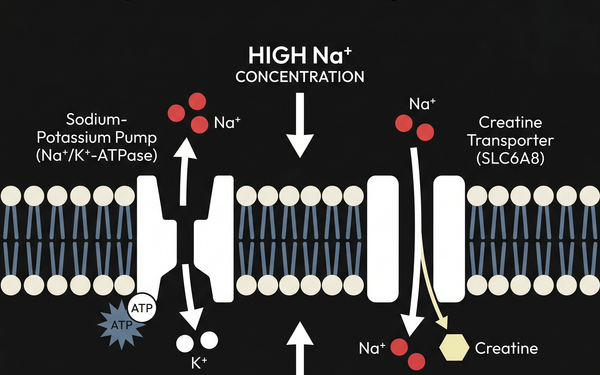
The diagram above shows the idea: sleep loss drains the brain's fast battery, and creatine helps top it back up.
WHAT THE STUDIES ACTUALLY FOUND
The Gordji-Nejad trial used a deliberately high single dose, around 0.35 grams per kilogram of body weight, which works out to roughly 25 grams for a typical adult. That is far above a normal daily serving, chosen to flood the system for a one-off test. After about 21 hours awake, the supplemented group held their cognitive performance better than on placebo, with the benefit appearing from around three hours, peaking near the four hour mark, and lasting up to about nine hours. The improvements showed up on tests of processing speed and across a battery of cognitive tasks, the kind of measures that track how quickly and accurately a tired brain can take in information and act on it.
The groundwork was laid nearly two decades earlier. In 2006, McMorris and colleagues gave people creatine for a week, then kept them awake for 24 hours. The supplemented group showed significantly less deterioration in reaction time, balance and mood than the placebo group. A follow-up in 2007 pushed the sleep deprivation further, to 36 hours, and found the clearest benefit on a demanding executive-function task emerged at that deepest point of sleep loss, not earlier.
This is where it gets interesting, and where honesty matters. That pattern, bigger effects when sleep loss is more severe and the task is harder, is the consistent thread, but the effect itself is small. A 2023 review in Sports Medicine by Candow and colleagues, summarising this literature, describes creatine as having only a minor effect on cognition under sleep deprivation, one that seems to depend on longer durations of sleep loss and more complex tasks. And the standout cognitive rescue in the Gordji-Nejad study came from that single very high dose, not from ordinary daily supplementation. So this is not a promise that one scoop will rescue your Monday after a bad Sunday night.
The broader cognition research points the same modest way. A 2024 meta-analysis by Xu and colleagues, pooling 16 randomised controlled trials and 492 adults, found creatine improved memory overall, with the larger effects clustering in people whose brains were under some form of physiological challenge. That is consistent with the sleep-deprivation idea rather than direct proof of it, but it fits the same picture: creatine seems to help most when the brain is working hardest with the least to spare.
There is one tangential but intriguing thread worth a mention. A separate 2024 trial by Aguiar Bonfim Cruz and colleagues reported that creatine was associated with more total sleep on heavy training days in naturally menstruating women. That is a different outcome from everything above, about how much you sleep rather than how a sleep-starved brain performs, and it is a small early finding, but it hints that the relationship between creatine and sleep runs in more than one direction.
WHO IS ACTUALLY LIVING THIS
Sleep deprivation in a lab is a stand-in for something millions of people live every week. Shift workers whose body clocks never settle. New parents surviving on fragments of a night. Long-haul travellers fighting jet lag. Students, carers, on-call professionals, anyone whose sleep is regularly broken by something outside their control. This is not a fringe group. Survey after survey finds that a large share of working adults regularly fall short of the sleep they need, and for many it is not a shortfall they can simply choose to reverse. That is precisely why a low-cost, well-tolerated nutrient with even a modest effect on the sleep-deprived brain has drawn the attention it has.
It is important to be straight about this: creatine has not been tested directly in shift workers, new parents or for jet lag. There are no trials in those groups. What the research studies is the underlying state they all share, acute sleep loss, in healthy volunteers. So the honest framing is not creatine fixes shift work, but rather that the sleep-deprived state these people live in is the same state where creatine has shown a modest benefit in controlled studies. That is a reasonable basis for interest, not a proven result for any one group.
WHAT TO ACTUALLY DO WITH THIS
Start with the obvious, because the research is unanimous on it: nothing replaces sleep. Sleep does jobs, memory consolidation, cellular repair, emotional regulation, that no supplement can stand in for. Creatine does not let you get away with less of it, and anyone selling it that way is misreading the science.
It also helps to separate two different situations. One is the occasional, unavoidable bad night: the newborn, the red-eye flight, the night before a deadline. The other is chronic short sleep that has quietly become a way of life. Creatine has nothing to offer the second except the reminder that the real fix is structural, more sleep and better sleep, not a supplement. It is the occasional unavoidable nights where the modest help the research describes is most relevant, and even there it sits on top of the basics rather than replacing them.
What the evidence does support is more modest and more useful. If you already take creatine daily for the usual reasons, keeping your levels topped up means your brain carries a fuller rapid-energy reserve into the days when sleep was poor. You are not dosing for the bad night when it happens. You are simply better stocked for it because you were consistent. Pairing that with your usual morning coffee is sensible, since the two work differently: caffeine lifts alertness for a few hours, while a saturated creatine system gives the tired brain a little more fuel to draw on underneath.
This is part of the thinking behind Creayate, which provides 4 grams of creatine monohydrate per sachet, comfortably above the 3 grams a day at which creatine is recognised to increase physical performance in successive bursts of short-term, high-intensity exercise. The sleep and cognition research described here is an active, developing field rather than a settled product benefit, and Creayate is a food supplement, not a treatment for tiredness or any sleep condition, and certainly not a substitute for sleep itself.
The single most useful thing you can do tomorrow is still the least glamorous: protect your sleep where you can. For the nights you genuinely cannot, a consistently topped-up creatine routine and a sensible coffee are a reasonable pair to lean on, with realistic expectations about how much they can do.
Key Takeaways
1. In lab studies, creatine modestly helped people preserve mental performance during sleep deprivation, and a 2024 study showed it shifted the brain's actual energy chemistry. 2. The effect is clearest when sleep loss is severe and the task is demanding, and the standout result came from a single high research dose, not ordinary daily dosing. 3. Creatine has not been tested in shift workers, new parents or for jet lag, so those are real-world examples of the same sleep-deprived state, not proven results. 4. Nothing replaces sleep; creatine may help a tired brain cope, but it is not a sleep aid or a substitute for rest.
The bottom line: Creatine appears to give the sleep-deprived brain a little more fuel to run on, a modest and genuine effect, but it tops up your sleep rather than replacing it.
SOURCES
1. Gordji-Nejad A, Matusch A, Kleedörfer S, et al. Single dose creatine improves cognitive performance and induces changes in cerebral high energy phosphates during sleep deprivation. Scientific Reports. 2024;14(1):4937. https://pubmed.ncbi.nlm.nih.gov/38418482/
2. McMorris T, Harris RC, Swain J, et al. Effect of creatine supplementation and sleep deprivation, with mild exercise, on cognitive and psychomotor performance, mood state, and plasma concentrations of catecholamines and cortisol. Psychopharmacology. 2006;185(1):93-103. https://pubmed.ncbi.nlm.nih.gov/16416332/
3. McMorris T, Harris RC, Howard AN, et al. Creatine supplementation, sleep deprivation, cortisol, melatonin and behavior. Physiology and Behavior. 2007;90(1):21-28. https://pubmed.ncbi.nlm.nih.gov/17046034/
4. Candow DG, Forbes SC, Ostojic SM, et al. "Heads Up" for creatine supplementation and its potential applications for brain health and function. Sports Medicine. 2023;53(Suppl 1):49-65. https://pubmed.ncbi.nlm.nih.gov/37368234/
5. Xu C, Bi S, Zhang W, Luo L. The effects of creatine supplementation on cognitive function in adults: a systematic review and meta-analysis. Frontiers in Nutrition. 2024;11:1424972. https://pubmed.ncbi.nlm.nih.gov/39070254/
6. Aguiar Bonfim Cruz AJ, Brooks SJ, Kleinkopf K, et al. Creatine improves total sleep duration following resistance training days versus non-resistance training days among naturally menstruating females. Nutrients. 2024;16(16):2772. https://pubmed.ncbi.nlm.nih.gov/39203908/
This article is for informational purposes only and is not intended as medical advice. It is not a treatment for any sleep disorder. If you have ongoing problems with sleep or fatigue, consult a qualified healthcare professional. </content>