

Across 685 clinical trials and more than 26,000 people, creatine supplementation did not worsen a single marker of kidney function.
That is not a cautious reading of the evidence. It is the headline finding of a 2025 safety review that pooled the entire trial record, looked specifically at the kidney markers doctors actually measure, and found the creatine groups and the placebo groups indistinguishable. Microalbumin, creatinine clearance, estimated filtration rate, urinary protein. No difference on any of them.
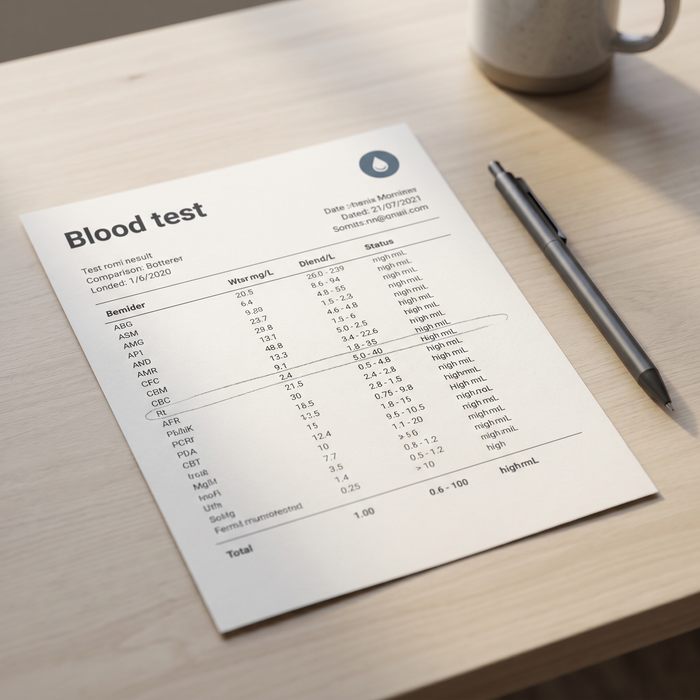
And yet, every year, people are told to come off creatine because a routine blood test came back with a slightly raised number. The number is usually real. The conclusion drawn from it is usually wrong. The whole confusion comes down to two words that sound almost identical and mean very different things: creatine and creatinine.
WHY THE TEST GETS BLAMED
Here is the story most people have absorbed. Creatine is hard on your kidneys. Your kidneys filter your blood, a blood test measures how well they are doing it, and if you load up on a supplement, the test gets worse. It sounds mechanically sensible. It is also built on a misunderstanding of what the test is actually measuring.
The standard kidney blood test does not measure your kidney function directly. It measures the level of a waste product called creatinine in your blood, and then it runs that number through a formula to estimate how well your kidneys are filtering. That estimate carries a hidden assumption: that the amount of creatinine your body produces is stable and predictable. For most people, on most days, it is. Take a creatine supplement, and you quietly break the assumption the whole test rests on. The marker moves. The kidneys do not.
WHERE CREATININE ACTUALLY COMES FROM
To see why, follow the molecule. Creatine is stored mostly in your muscles, where it works as a rapid energy buffer for short, hard efforts. Every day, a small and fairly constant fraction of that pool, roughly 1 to 2 percent, spontaneously breaks down into creatinine. Creatinine is a dead end. It has no further use, so your body tips it into the blood, your kidneys filter it out, and it leaves in your urine.
This steady trickle is exactly what makes creatinine such a convenient kidney marker. Because production is normally stable, the level in your blood depends mostly on how fast your kidneys clear it. If filtration slows, creatinine backs up and the blood level climbs. So a high creatinine usually does suggest the kidneys are working harder than they should have to. Usually.
Now add a supplement. When you take 3 to 5g of creatine a day, you enlarge the creatine pool in your muscles. A larger pool produces more creatinine through that same daily breakdown. More creatinine enters the blood, not because your kidneys have slowed down, but because there is simply more of it being made. The blood level rises. The filtration rate behind it has not changed at all.

The diagram above shows the pathway. It helps to think of blood creatinine as smoke and kidney function as the fire. Normally, more smoke means a bigger fire, so it is sensible to watch the smoke. Creatine supplementation wheels a second smoke machine into the room. The alarm goes off. There is no extra fire.
This matters because of how the result reaches you. The estimated glomerular filtration rate, or eGFR, printed on your blood test is calculated from your blood creatinine alongside your age and sex. Push creatinine up with a supplement and the formula mechanically pushes the eGFR estimate down, flagging a kidney decline that exists only on paper.
There is a second wrinkle the formula struggles with, and it has nothing to do with supplements at all. Creatinine production is roughly proportional to muscle mass, because muscle is where the creatine pool lives. A lean, muscular, well-trained adult therefore produces more creatinine every single day than the average person the formula was calibrated on, and carries a higher baseline blood level as a result. Their kidneys are usually in excellent shape. The estimate simply was not designed with them in mind, and it can read healthy muscle as a problem. Add a creatine supplement on top of an already muscular frame and you have two perfectly innocent reasons for the number to sit above the reference range.
WHAT HAPPENS WHEN YOU MEASURE PROPERLY
So what does the research find when it stops trusting the estimate and measures kidney function directly? The picture is consistent and reassuring.
A 2025 systematic review and meta-analysis in BMC Nephrology by Kabiri Naeini and colleagues pooled 12 controlled studies covering 177 supplemented participants and 263 controls. It found that creatine produced a small, statistically significant rise in serum creatinine. When the same analysis turned to glomerular filtration rate, the actual measure of kidney performance, there was no significant difference between creatine and placebo. The marker moved. The function did not.
The strongest individual evidence comes from trials that measure filtration with gold-standard methods rather than estimating it from a blood number. In a 2013 randomised, double-blind, placebo-controlled trial published in the Journal of the International Society of Sports Nutrition, Lugaresi and colleagues followed resistance-trained men for 12 weeks. Crucially, the men were eating a high-protein diet, the exact scenario the creatine-plus-protein worry is built around. The researchers measured GFR using 51Cr-EDTA clearance, a tracer method far more accurate than any blood estimate. Kidney function did not change.
This is where it gets interesting. The very test that raises the alarm is the one creatine is uniquely able to fool, and the tests that cannot be fooled keep coming back normal.
Longer follow-up tells the same story. Back in 1999, Poortmans and Francaux studied athletes who had been taking creatine for between 10 months and 5 years and compared their kidney markers against non-users, publishing in Medicine and Science in Sports and Exercise. They found no difference in the clearance of creatinine, urea, or albumin, and no sign of impaired filtration. Years of supplementation, normal kidneys.
None of this is a fringe view. The International Society of Sports Nutrition, in its 2017 position stand led by Kreider and colleagues, states plainly that there is no compelling evidence that creatine supplementation negatively affects kidney function in healthy or clinical populations. The same document notes that even high doses taken over long periods, including up to 30g a day for as long as five years in clinical populations, have not been linked to kidney dysfunction.
And the 2025 safety review mentioned at the top, also led by Kreider and colleagues, went broad rather than deep: 685 trials, 26,291 participants, every renal marker they could pull. None separated creatine from placebo. What makes that review hard to wave away is its breadth. It did not rest on trial data alone, but also combed worldwide adverse-event reporting databases for any signal of harm. If creatine were quietly damaging kidneys at the population level, that is precisely where it would surface. It did not.
THE HONEST CAVEATS
Two things are worth saying plainly, because glossing over them is its own kind of bad science.
First, almost all of this evidence is in people who started with healthy kidneys. If you already have kidney disease, your situation is genuinely different, and it is a conversation for your doctor rather than a blog post. The research clears creatine for healthy people. It does not hand a free pass to everyone in every circumstance.
Second, creatine is not the only ordinary thing that nudges creatinine upward. A high-protein diet and a hard training session can both raise it too. This is one reason active people so often see numbers that would look mildly alarming in someone sedentary and yet mean nothing of the sort. Context is everything, and a single out-of-range value on an otherwise clean panel is a prompt to look closer, not to panic.
The sensible middle ground is the same one good clinicians already use. A flagged result on a screening test is a question, not a diagnosis. If you have genuine risk factors for kidney disease, a family history, diabetes, or high blood pressure, then your kidney health is worth monitoring regardless of whether you supplement, and the right move is a proper assessment rather than guesswork in either direction. For everyone else, the weight of the evidence is settled enough that a mildly raised creatinine in an otherwise healthy, active person is far more likely to be the molecule doing exactly what it is supposed to than a sign of anything going wrong.
WHAT THIS MEANS FOR YOU
The practical takeaway is simple.
If you supplement creatine and you are booked in for a blood test, the most useful thing you can do is mention it. A serum creatinine or eGFR result reads completely differently once the clinician knows you take creatine. If there is any genuine concern, kidney function can be checked a different way. A cystatin C based estimate, for instance, uses a different blood protein entirely, does not depend on creatinine, and sidesteps the whole problem.
A concrete tip if a number has already spooked you. Before drawing any firm conclusion, ask whether the test can be repeated after a short pause from supplementing, or checked with cystatin C instead. A single creatinine reading taken the morning after a heavy training session, a high-protein day and your usual creatine is close to a worst-case snapshot, and it is exactly the reading most likely to be misread.
If you are healthy and your only red flag is a mildly raised creatinine on an otherwise normal panel, that is not a reason to abandon one of the most thoroughly safety-tested supplements in sports nutrition. The standard, well-studied dose is 3 to 5g of creatine monohydrate a day, taken consistently. There is no loading phase you must do and no need to cycle off.
This is part of why we built Creayate around 4g of creatine monohydrate per sachet, a dose chosen to match the standard, well-studied daily intake rather than chasing a bigger number for its own sake. Creayate is a food supplement, not a treatment for any condition. It is not a substitute for medical advice, and if you have an existing kidney problem or any other health concern you should speak to a qualified healthcare professional before starting.
Key Takeaways
- Creatinine is a waste product of creatine, so supplementing creatine raises blood creatinine without your kidneys slowing down.
- The standard eGFR test estimates kidney function from blood creatinine, which means a supplement can lower the estimate while true filtration is unchanged.
- When studies measure kidney function directly with gold-standard methods, creatine shows no impairment, even alongside a high-protein diet.
- Across 685 trials and more than 26,000 people, creatine did not worsen any kidney marker, though this evidence applies to people with healthy kidneys.
The bottom line: In healthy people, a raised creatinine on creatine is a measurement quirk, not kidney damage.
Sources
- Kabiri Naeini E, Eskandari M, Mortazavi M, et al. Effect of creatine supplementation on kidney function: a systematic review and meta-analysis. BMC Nephrology. 2025;26(1):622. pubmed.ncbi.nlm.nih.gov/41199218
- Lugaresi R, Leme M, de Salles Painelli V, et al. Does long-term creatine supplementation impair kidney function in resistance-trained individuals consuming a high-protein diet? Journal of the International Society of Sports Nutrition. 2013;10:26. pmc.ncbi.nlm.nih.gov/articles/PMC3661339
- Kreider RB, Gonzalez DE, Hines K, Gil A, Bonilla DA. Safety of creatine supplementation: analysis of the prevalence of reported side effects in clinical trials and adverse event reports. Journal of the International Society of Sports Nutrition. 2025;22(sup1):2488937. pmc.ncbi.nlm.nih.gov/articles/PMC11983583
- Kreider RB, Kalman DS, Antonio J, et al. International Society of Sports Nutrition position stand: safety and efficacy of creatine supplementation in exercise, sport, and medicine. Journal of the International Society of Sports Nutrition. 2017;14:18. pubmed.ncbi.nlm.nih.gov/28615996
- Poortmans JR, Francaux M. Long-term oral creatine supplementation does not impair renal function in healthy athletes. Medicine and Science in Sports and Exercise. 1999;31(8):1108-1110. pubmed.ncbi.nlm.nih.gov/10449011
- Poortmans JR, Francaux M. Adverse effects of creatine supplementation: fact or fiction? Sports Medicine. 2000;30(3):155-170. pubmed.ncbi.nlm.nih.gov/10999421
This article is for informational purposes only and is not intended as medical advice. If you have any existing kidney condition or other health concern, consult a qualified healthcare professional before changing your supplement routine.