

Trained female cyclists who loaded up on sodium before a time trial in the heat finished it more than a minute and a half faster, and they did it with no extra strain on the heart and no rise in core temperature.
That result, from a 2025 trial published in the International Journal of Sport Nutrition and Exercise Metabolism, points at something most people get backwards about hydration. We treat it as something to manage during a session, the bottle on the bench, or to fix afterwards, the big glass of water once you are home. The single most decisive window is the one almost everyone ignores: the hours before you start.
THE STARTING LINE YOU KEEP IGNORING
Picture the average person heading to the gym after a day at a desk. A couple of coffees, not much water, and they arrive already running a small fluid deficit without realising it. They will drink during the session if they remember, and they will rehydrate afterwards. What they will not do is the one thing the evidence rates most highly: turn up properly hydrated in the first place.
Starting a session in deficit is not a minor detail you can claw back later. Your blood volume is lower, your heart has to work harder to move it, your core temperature climbs faster, and the effort feels harder at every intensity. By the time thirst kicks in, you are already behind, and you spend the whole session chasing a deficit rather than performing. Hydration, done well, is mostly a pre-session job.
WHY THE STARTING LINE MATTERS MOST
The reason comes down to plasma volume, the watery part of your blood. Plasma is what carries oxygen-rich red cells to your muscles and ferries heat to your skin to be dumped. When you begin exercise already low on fluid, plasma volume is reduced before you have done a single rep. Your heart compensates by beating faster to maintain output, your ability to shed heat drops, and the same workout costs you more.
The American College of Sports Medicine, in its position stand on exercise and fluid replacement led by Sawka and colleagues, puts a number on the cost: beginning exercise dehydrated by more than about 2 percent of body mass measurably degrades performance, and the effect is worse in the heat. Two percent is not much. For an 80kg person it is a litre and a half of fluid, the kind of deficit you can accumulate across a busy day without noticing. The practical message is that the state you arrive in matters at least as much as what you drink once you have started.
GETTING TO THE START LINE HYDRATED
The fix is unglamorous and well established. The same position stand recommends drinking slowly in the hours beforehand rather than chugging at the last minute: roughly 5 to 7 millilitres of fluid per kilogram of body weight at least four hours before exercise, and another 3 to 5 millilitres per kilogram about two hours before if your urine is still dark or you have not needed the toilet. For a 70kg person that first drink is around 350 to 500 millilitres. The goal is simple: arrive euhydrated, with pale urine, rather than topping up frantically in the warm-up.

The diagram above shows that window. Drinking earlier and slower gives your body time to absorb the fluid and to pass off any genuine excess, so you start full rather than sloshing. A last-minute litre does the opposite, sitting in your gut and then heading for your bladder mid-session.
WHY SODIUM, NOT JUST WATER, BEFORE YOU TRAIN
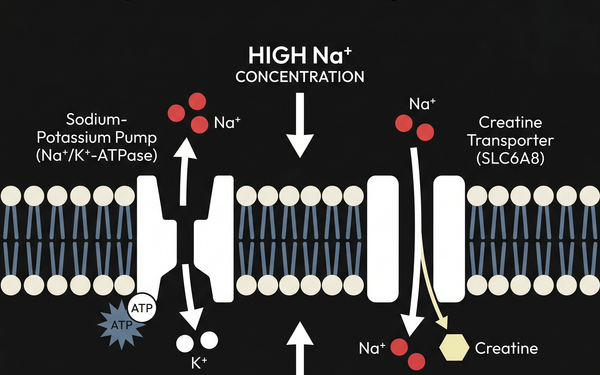
Here is where the plain-water approach falls short. When you drink water on its own, especially a large volume, your body reads the dilution of your blood as a signal to get rid of the excess, and a good fraction of it is gone before your session begins. Sodium changes that. Sodium is the main mineral in the fluid outside your cells, and taking it in alongside water helps you hold onto that water rather than flushing it. A drink with some sodium in it before training is retained better than the same volume of plain water, which means more of it is still on board when you need it.
The mechanism is the same one that governs how a rehydration drink works. Water is absorbed across the wall of your small intestine largely by following sodium, which is pulled across the gut wall first and tows water along behind it. Present the gut with sodium and fluid together and more of that fluid crosses into your bloodstream and stays there. Present it with water alone and a larger share simply passes through to your bladder.
Push that principle a little further and you arrive at sodium loading: deliberately taking in extra sodium and fluid before a hard effort to expand plasma volume above its normal level, a kind of pre-filling of the tank. This is the tactic the cyclists in that opening study were using.
WHAT THE SODIUM LOADING RESEARCH SHOWS
In the 2025 trial, Convit and colleagues took twelve endurance-trained female cyclists and, in a randomised, double-blind, placebo-controlled design, gave them either a strong sodium drink or a placebo in the two hours before a time trial performed in the heat. The sodium drink left the riders carrying about 0.38kg more retained fluid at the start line, and they completed the time trial roughly 1.55 minutes faster, with no increase in core temperature or heart rate. It is a small study, in women, in hot conditions, so it is not a universal prescription. But it is a clean demonstration that turning up with a deliberately fuller tank can pay off when the effort is hard.
How much sodium, and when? A 2025 review of sodium for athletes by McCubbin pulled the practical evidence together. For acute pre-exercise loading, fluids containing roughly 275 to 420 milligrams of sodium per 100 millilitres drive useful fluid retention, with a one-off load in the hours beforehand retained at around three quarters of what is taken in.
This is where it gets interesting. The same review is blunt about what does not work. Spreading salt across several days before an event, the old-school idea of salt loading days in advance, shows no benefit, does not prevent cramp, and does not protect against the dangers of overdrinking. The useful version of sodium loading is acute, done in the hours before, not a week-long project.
The broader principle holds up beyond the loading studies. A 2018 trial by Ayotte and Corcoran found that collegiate athletes given an individualised hydration plan, built from their own measured sweat rate and sweat sodium losses, jumped over four inches further in a standing long jump and recovered their heart rate faster after training than when they simply drank to thirst. The sample was small, fifteen athletes, so read it modestly, but it points the same way: matching fluid and sodium to what you actually lose beats guesswork. And a 2022 review by Veniamakis and colleagues on sodium in endurance sport sets out the underlying reason: sodium is what defends plasma volume, holding fluid in circulation and reducing the urine you lose, which is exactly what you want a session to start with.
THE OTHER DIRECTION MATTERS TOO
A word of balance, because hydration advice often tips into more-is-better and that is its own trap. Drinking large volumes of plain water before and during prolonged exercise, with no sodium to match, can dilute the sodium in your blood to dangerous levels, a condition called exercise-associated hyponatraemia that both the ACSM and the National Athletic Trainers Association warn about. Including sodium with your fluid is part of what protects against it, which is one more reason the two belong together. The point is not to drown yourself in fluid. It is to arrive appropriately topped up, with sodium in the mix.
It is also worth being honest about who sodium loading is for. The evidence sits around hard, hot, or competitive efforts, not the average half-hour gym session, and it is a performance tactic for active people rather than a reason for anyone with high blood pressure or salt sensitivity to raise their everyday salt intake.
WHAT TO ACTUALLY DO
None of this needs to become a spreadsheet. The amount you lose in sweat varies enormously from one person to the next, which is exactly why the individualised approach in the research outperforms blanket advice, but most people capture most of the benefit from two habits: arriving hydrated, and adding sodium when the session is genuinely demanding. You can sharpen it over time by noticing how you feel and perform on the days you get it right.
For a normal training day, the priority is simply to arrive hydrated. Drink steadily through the hours beforehand rather than all at once, aim for pale urine before you start, and if you train in the morning, have a drink on waking rather than rushing out on an overnight deficit. Worth remembering too that the morning coffee most of us rely on is mildly diuretic, nudging you toward the start line slightly drier than you assume.
For a hard session, a long one, or anything in the heat, add sodium to that pre-session fluid. A sodium-containing drink in the hour or two before you start carries more sodium than the trace found in most drinks. This is part of why we built Creayate with 800mg of sodium per sachet, rather than the trace amount that plain drinks provide. Creayate is a food supplement, not a substitute for a balanced diet or for medical advice, and if you have high blood pressure, are sensitive to sodium, or have any heart or kidney condition, check with a qualified healthcare professional before increasing your sodium intake.
One change you can make tomorrow: move your electrolyte drink to before your session instead of sipping it halfway through. Same drink, better timing, and you start the workout already ahead instead of trying to catch up.
Key Takeaways
1. Beginning exercise dehydrated by more than about 2 percent of body mass measurably hurts performance, so the hours before a session matter more than most people think. 2. Drinking steadily in the hours beforehand, around 5 to 7 millilitres per kilogram at least four hours out, gets you to the start line euhydrated. 3. Sodium helps you retain pre-session fluid, and in one 2025 trial, sodium loading before a hot time trial improved female cyclists' times by about a minute and a half with no extra strain. 4. Acute sodium loading in the hours before works; multi-day salt loading does not, and overdrinking plain water carries its own risk.
The bottom line: Win the hydration battle before you start, and add sodium when the effort is hard, because what you arrive with matters as much as what you drink during.
SOURCES
1. Convit L, Orellana L, Périard JD, et al. Sodium hyperhydration improves performance with no change in thermal and cardiovascular strain in female cyclists exercising in the heat across the menstrual cycle. International Journal of Sport Nutrition and Exercise Metabolism. 2025;35(2):99-111. https://pubmed.ncbi.nlm.nih.gov/39591960/
2. McCubbin AJ. Sodium intake for athletes before, during and after exercise: review and recommendations. Performance Nutrition. 2025;1:11. https://doi.org/10.1186/s44410-025-00011-9
3. Sawka MN, Burke LM, Eichner ER, et al. American College of Sports Medicine position stand. Exercise and fluid replacement. Medicine and Science in Sports and Exercise. 2007;39(2):377-390. https://pubmed.ncbi.nlm.nih.gov/17277604/
4. Ayotte D, Corcoran MP. Individualized hydration plans improve performance outcomes for collegiate athletes engaging in in-season training. Journal of the International Society of Sports Nutrition. 2018;15:27. https://pmc.ncbi.nlm.nih.gov/articles/PMC5987390/
5. Veniamakis E, Kaplanis G, Voulgaris P, et al. Effects of sodium intake on health and performance in endurance and ultra-endurance sports. International Journal of Environmental Research and Public Health. 2022;19(6):3651. https://pmc.ncbi.nlm.nih.gov/articles/PMC8955583/
6. McDermott BP, Anderson SA, Armstrong LE, et al. National Athletic Trainers' Association position statement: fluid replacement for the physically active. Journal of Athletic Training. 2017;52(9):877-895. https://pubmed.ncbi.nlm.nih.gov/28985128/
This article is for informational purposes only and is not intended as medical advice. If you have high blood pressure, are sensitive to sodium, or have any heart or kidney condition, consult a qualified healthcare professional before changing your sodium or fluid intake. </content>